
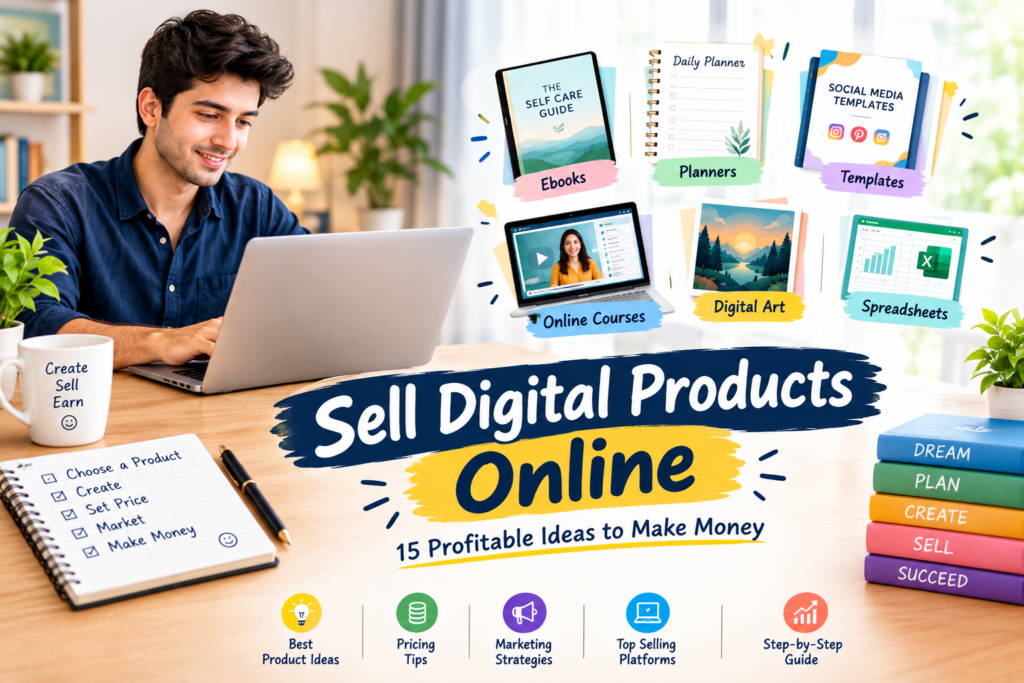
Sell Digital Products Online: 15 Profitable Ideas to Make Money
Introduction
Sell digital products online is one of the most popular ways to build an online income stream without managing physical inventory or shipping products to customers. Whether you are a student, freelancer, stay-at-home parent, or someone looking for extra income, selling digital products can be a flexible way to turn your knowledge and creativity into money.
Digital products are items that customers purchase and download or access online. Examples include ebooks, online courses, templates, digital planners, stock photos, website themes, and printable worksheets. Once you create a product, you can potentially sell it to multiple customers without making a new physical item for every order.
However, earning money from digital products is not automatic. You need to choose a product people want, create something useful, set a reasonable price, and promote it to the right audience.
In this guide, you will learn how to sell digital products online, discover 15 profitable product ideas, explore popular selling platforms, and understand how to market your products effectively.
What Are Digital Products?
Digital products are goods delivered electronically rather than as physical items. Customers usually receive a download link, access to an online platform, or an email containing their purchase.
For example, if you create a budget planner in PDF format, customers can purchase it and download it immediately. You do not need to print the planner, package it, or visit a shipping office.
Some common digital products include:
- Ebooks and digital guides
- Online courses and tutorials
- Printable planners and calendars
- Website templates and themes
- Graphic design templates
- Stock photographs and illustrations
- Digital art and illustrations
- Music, sound effects, and audio files
- Resume and cover letter templates
- Spreadsheet templates
- Social media content calendars
- Business documents and checklists
Digital products are useful because they can serve customers in different countries and industries. You can start with one product and gradually expand your collection based on customer feedback.
Why Sell Digital Products Online?
There are several reasons why people choose digital products as an online business model.
1. Low Startup Costs
You do not necessarily need a large investment to begin. Free or affordable tools can help you create ebooks, worksheets, graphics, and simple templates.
For example, you can use Canva to design a planner or Google Docs to write an ebook. Some platforms also allow you to start selling without paying a monthly subscription, although transaction fees may apply.
2. No Physical Inventory
Traditional businesses often need storage space, packaging materials, and inventory management. Digital products generally eliminate these requirements.
After creating your product, you can store the files digitally and deliver them electronically when customers place orders.
3. Flexible Working Hours
Selling digital products can be suitable for people who want to work from home or manage a side hustle alongside another job.
You can create products during your free time, schedule promotional content, and handle customer questions when convenient. The amount of work depends on your product and business model.
4. Potential for Repeat Sales
One digital product can be sold multiple times. For example, a well-designed resume template may appeal to job seekers for months or years, although you may need to update it as customer needs change.
This does not guarantee passive income. You still need to maintain your products, answer customer questions, and attract new buyers.
5. Access to Global Customers
An online store can help you reach customers beyond your city or country. Someone looking for a wedding planner, business spreadsheet, or social media template may be interested in your product regardless of where you live.
Payment availability, platform rules, and local tax requirements can affect which countries you can serve.
15 Profitable Digital Products You Can Sell Online
If you are wondering what to sell, start by considering your skills, interests, and the problems people are willing to pay to solve.
1. Sell Ebooks Online
Ebooks are a practical option for people who enjoy writing or have knowledge about a particular subject.
You could create ebooks about personal budgeting, cooking, fitness routines, freelancing, productivity, or learning a new skill.
For example, a beginner-friendly guide explaining how to create a freelance portfolio could help new freelancers get started.
To create a useful ebook, select a specific topic, organize your information into chapters, and provide actionable advice. Design the final document as a PDF and include a clear title page and table of contents.
You can sell ebooks through your own website or a suitable digital marketplace.
2. Create Printable Planners
Printable planners help customers organize their schedules, goals, finances, and everyday tasks.
Popular ideas include daily planners, weekly schedules, meal planners, habit trackers, study planners, and wedding planners.
You can create these products using Canva or another design tool. Make sure the pages are readable and easy to print.
A small collection of related planners can also be sold as a bundle, giving customers more value than purchasing individual pages.
3. Sell Canva Templates
Canva templates are useful for people who need attractive designs but do not want to create everything from scratch.
You could design Instagram posts, Pinterest pins, presentation slides, business cards, flyers, or media kits.
For instance, a social media template pack for small businesses could help business owners maintain a consistent visual style.
Focus on a particular audience instead of creating generic templates for everyone. Always follow Canva’s current licensing rules and ensure that your products contain original designs or elements you are permitted to redistribute.
4. Create Online Courses
If you have expertise in a subject, an online course can help you turn that knowledge into a digital product.
Possible subjects include graphic design, writing, photography, basic coding, language learning, and spreadsheet skills.
Start with a specific learning outcome. A course called “Build Your First WordPress Website” is more focused than a broad course about computers.
You can deliver lessons through videos, presentations, written materials, exercises, or a combination of these formats.
Before creating a large course, consider testing demand with a short workshop or a small introductory course.
5. Sell Resume and Cover Letter Templates
Job seekers often need professional resumes and cover letters that are easy to customize.
You can create templates for students, fresh graduates, experienced professionals, or people changing careers.
Include clear instructions for editing the files and offer formats that customers can use with common software.
Avoid promising that a particular resume design will guarantee employment. Your product should help customers present their experience clearly rather than make unrealistic claims.
6. Sell Spreadsheet Templates
Spreadsheets can solve practical problems for individuals and businesses.
Examples include monthly budget trackers, savings planners, invoice templates, project trackers, and small-business expense sheets.
You can create products using Google Sheets or Microsoft Excel.
A good spreadsheet should be easy to understand, with clear labels, useful formulas, and sample data that customers can replace with their own information.
Test your formulas before selling the file. Even a simple template becomes more valuable when it saves users time and reduces repetitive work.
7. Sell Social Media Content Calendars
Businesses and content creators need to plan posts consistently. A social media content calendar can help them organize ideas, publishing dates, captions, and campaign goals.
You could sell a calendar designed for restaurants, online shops, coaches, real estate agents, or personal brands.
Consider including a monthly planning sheet, caption prompts, hashtag research guidelines, and a basic posting schedule.
The more specific the calendar is to a customer’s needs, the easier it may be to explain its value.
8. Create Stock Photos
If you enjoy photography, you can sell digital photographs through stock photography websites or other platforms that support image licensing.
Potential subjects include workspaces, food, travel, nature, business activities, and everyday lifestyle scenes.
Businesses, bloggers, designers, and marketers may purchase images for their projects.
Learn about image quality, model releases, property permissions, and licensing requirements before uploading your work. Do not sell photographs that you do not own or have permission to license.
9. Sell Digital Art and Illustrations
Digital artists can sell illustrations, icons, wallpapers, patterns, stickers, and other creative assets.
You might create downloadable artwork for home decoration or digital illustrations for designers and content creators.
Choose a clear theme for your collection, such as minimalist art, nature illustrations, educational graphics, or seasonal designs.
Include suitable file formats and dimensions in your product description so customers understand exactly what they are buying.
10. Sell Website Templates and Themes
Website templates can help beginners, freelancers, and small businesses build websites more efficiently.
If you understand web design, you can create landing page layouts, portfolio templates, blog themes, or website sections.
Depending on your technical skills, you might work with WordPress, HTML, CSS, or supported website builders.
Test your templates on different screen sizes and provide basic installation instructions. Customers appreciate products that are easy to set up and maintain.
11. Create Digital Worksheets
Educational worksheets can help students, teachers, parents, and tutors.
Examples include mathematics practice sheets, vocabulary exercises, reading activities, handwriting worksheets, and language-learning resources.
You can organize related worksheets into themed packs for a specific age group or learning level.
Make sure the instructions are clear, the answers are correct, and the pages are suitable for the intended learners. If you use third-party educational content, verify that you have the necessary rights.
12. Sell Audio Files and Music
Musicians and audio creators can sell background music, sound effects, meditation audio, jingles, and other original recordings.
Potential customers include video editors, podcasters, content creators, and businesses.
Offer clear information about file formats, duration, and licensing permissions. Explain whether buyers can use the files in commercial projects and whether attribution is required.
Only sell audio that you created or have the legal right to distribute.
13. Sell Business Document Templates
Small businesses frequently use documents such as proposals, invoices, onboarding checklists, meeting agendas, and project briefs.
You can create editable templates that help business owners save time and maintain a professional appearance.
Consider targeting a specific industry, such as freelance design, consulting, photography, or virtual assistance.
Include instructions explaining how to customize the documents. For legal or financial documents, avoid presenting general templates as professional advice or guaranteed-compliant forms.
14. Create AI Prompt Packs
People who use AI tools sometimes need structured prompts for specific tasks.
You could create prompt collections for brainstorming blog topics, planning social media posts, organizing research, or generating business ideas.
A useful prompt pack should include clear instructions, examples, and suggestions for adapting the prompts to different needs.
Avoid simply collecting generic prompts. Test your prompts, explain their purpose, and make sure your marketing accurately describes what customers receive.
Also check the relevant AI platform’s terms and avoid promising that every output will be accurate or unique.
15. Sell Digital Bundles
A digital bundle combines several related products into one package.
For example, a freelancer bundle could include a resume template, cover letter template, portfolio layout, invoice spreadsheet, and client onboarding checklist.
Bundles can make it easier for customers to purchase several useful resources at once.
Choose products that work well together rather than adding unrelated files just to increase the number of items. Clearly list everything included in the package.
Best Platforms to Sell Digital Products Online
Choosing the right platform is an important step. Compare fees, payment options, product delivery, customization, and customer access before making a decision.
1. Etsy
Etsy is known for creative products, including printables, planners, artwork, and certain digital downloads.
It may be useful if your products fit the marketplace’s audience and policies.
However, seller eligibility, payment availability, listing fees, and other charges vary. Check the current rules for your country before investing time in setting up a shop.
2. Gumroad
Gumroad provides tools for selling digital downloads and other creator products.
It can be suitable for ebooks, guides, templates, and downloadable resources. You can share product pages directly with your audience.
Review its current fees, payout options, and supported countries before choosing it.
3. Payhip
Payhip supports digital downloads and other types of products, depending on its current features and plan.
It may be a useful option for creators who want a straightforward storefront.
Check the available payment processors, transaction charges, and regional restrictions before opening your store.
4. Shopify
Shopify is an ecommerce platform that allows you to build a branded online store.
It can be useful if you want more control over your storefront and plan to sell several products. Digital delivery may require an appropriate app or integration.
Consider the subscription cost, payment processing fees, and setup requirements when deciding whether it fits your budget.
5. Your Own WordPress Website
If you already have a WordPress website, you may be able to sell digital products directly through it.
Tools such as Easy Digital Downloads or WooCommerce can support digital product sales when configured appropriately.
Your own website gives you more control over branding and content. However, you will need to manage security, backups, customer support, payment integration, and marketing.
Before selecting any platform, confirm that it supports sellers and payouts in your country. This is especially important if you are starting from Pakistan or another country with limited payment-provider availability.
How to Sell Digital Products Online Step by Step
You do not need to create dozens of products on your first day. A focused approach can help you test your idea without wasting time.
Step 1: Choose a Specific Niche
Start with a subject you understand or are willing to research.
Examples include education, productivity, personal budgeting, graphic design, blogging, and small-business organization.
Instead of targeting everyone, identify a particular group of customers. For example, “budget planners for university students” is more specific than “digital planners.”
Step 2: Research Customer Needs
Before creating your product, find out what potential customers are searching for.
Explore marketplace listings, online communities, customer reviews, and search suggestions. Pay attention to repeated complaints and requests.
If buyers frequently mention that existing planners are confusing, you might create a simpler version with clear instructions.
Research does not guarantee sales, but it can help you choose a product that solves a real problem.
Step 3: Create a Useful Product
Use suitable tools to produce your first version.
Canva can help with graphics and printables. Google Docs is useful for written guides, while Google Sheets can be used for trackers and calculators.
Focus on quality, readability, accuracy, and ease of use. Check spelling, test links, and verify that files open correctly before publishing.
Step 4: Set a Reasonable Price
Your price should reflect the usefulness of the product, the effort involved, competing offers, and your target customers.
For example, a simple one-page checklist may be priced differently from a detailed ebook or a comprehensive business template bundle.
Research comparable products, but do not automatically choose the lowest price. Explain the value of your product and what makes it useful.
Remember to account for platform fees, payment processing, taxes, refunds, and other business costs.
Step 5: Create a Professional Product Listing
Your product page should explain what the customer receives and how it helps.
Include a clear product title, detailed description, preview images, file formats, page count where relevant, and instructions for use.
Mention any limitations, software requirements, or printing recommendations. Avoid misleading previews or claims about guaranteed results.
A clear listing helps customers make informed purchasing decisions and may reduce unnecessary support requests.
Step 6: Set Up Digital Delivery
Configure your chosen platform so customers can access their purchases after payment.
Test the checkout and download process yourself if possible. Verify that download links work and that customers receive the correct files.
Keep backup copies of your products and maintain a simple process for handling lost download links or technical problems.
Step 7: Promote Your Products
Creating a product is only one part of the process. Customers need to discover it.
You can promote your products through search-engine-optimized blog posts, Pinterest, social media, email newsletters, short videos, and relevant online communities.
Choose one or two channels that suit your audience instead of trying to manage every platform at once.
Step 8: Improve Based on Feedback
Monitor visits, product views, sales, customer questions, and refund requests.
If people visit your listing but rarely buy, consider improving your product images, title, description, or price. If buyers repeatedly request the same feature, you may have an opportunity to update the product.
Make changes based on evidence rather than assuming that every product will become successful immediately.
How to Market Digital Products Without Spending Much Money
You can begin promoting digital products without a large advertising budget.
Use SEO to Attract Organic Traffic
Search engine optimization can help potential customers find your products through Google and other search engines.
Use relevant keywords in your page title, product description, headings, and image alt text where appropriate. Write helpful blog posts that answer questions related to your product.
For example, if you sell budget planners, you could publish articles about managing monthly expenses or creating a savings plan.
Avoid keyword stuffing. Content should be natural, useful, and written for readers.
Promote Products on Pinterest
Pinterest can be useful for visually appealing products such as planners, templates, worksheets, and printable artwork.
Create clear pins that show what your product does. Link each pin to the relevant product page or a helpful article on your website.
Use descriptive titles and descriptions that match the content of the destination page.
Use Social Media
Share product demonstrations, tutorials, design tips, and examples of how your products work.
For example, a creator selling spreadsheet templates could publish a short demonstration showing how a customer can track monthly expenses.
Focus on providing useful information rather than repeatedly posting sales messages.
Build an Email List
An email list can help you communicate with people who are interested in your products.
You might offer a free checklist or sample template in exchange for voluntary email subscriptions. Then send helpful tips, product updates, and relevant offers.
Use an email service that supports your needs and follow applicable privacy and marketing laws.
Publish Helpful Blog Content
A blog can attract people who are researching a problem that your product solves.
If you sell resume templates, write about resume formatting, common mistakes, and ways to organize work experience.
Include relevant links to your products where they genuinely help readers. Over time, useful content may bring visitors who are already interested in your topic.
Common Mistakes to Avoid
Many beginners make avoidable mistakes when starting a digital product business.
Creating products without research: A product may look attractive but still have little demand. Research customer problems before investing significant time.
Copying other creators: Do not copy another seller’s designs, text, images, or files. Create original work and respect intellectual property rights.
Ignoring product quality: Incorrect formulas, broken links, spelling mistakes, and confusing instructions can lead to complaints and refunds.
Expecting instant income: A new store may need time to build trust, attract visitors, and improve its offers. There is no guaranteed income level or timeline.
Choosing too many niches: Selling unrelated products can make it difficult to develop a clear brand. Start with a focused audience and expand when you understand its needs.
Ignoring customer support: Provide clear instructions and respond professionally to reasonable questions. Good support can improve the buying experience.
Forgetting business costs: Platform fees, software subscriptions, payment charges, taxes, and refunds can reduce your profit. Track expenses from the beginning.
How Much Money Can You Make Selling Digital Products?
Income varies widely depending on product quality, customer demand, pricing, marketing, competition, and operating costs.
Some sellers make occasional sales, while others develop larger businesses over time. Many products receive few or no sales, especially when they lack demand or visibility.
Consider a simple hypothetical example. If you sell a digital planner for $10 and receive 20 sales in a month, your gross revenue would be $200 before fees, taxes, refunds, and other expenses.
If you sell a template bundle for $20 and receive 50 sales, your gross revenue would be $1,000 before costs.
These figures are illustrations, not earnings predictions or guarantees. Actual sales depend on your circumstances, and the number of visitors needed to achieve them can vary substantially.
Instead of focusing only on income goals, begin by validating your product, making your first sales, and learning which marketing channels attract interested customers.
Tips for Long-Term Success
To build a more sustainable digital product business, focus on customer value and continuous improvement.
- Start with one useful product and expand gradually.
- Target a clearly defined customer group.
- Create original, high-quality products.
- Use honest descriptions and realistic marketing claims.
- Keep your files updated when necessary.
- Make checkout and downloads simple.
- Track revenue and expenses regularly.
- Learn basic SEO and content marketing.
- Collect customer feedback responsibly.
- Review platform rules and licensing requirements.
- Build your own audience instead of relying on a single source of traffic.
You can also create related products over time. For example, someone selling a beginner budgeting spreadsheet might later offer a savings tracker, monthly expense planner, and personal finance workbook.
A related product collection can serve the same audience while giving customers more options.
Conclusion
Sell digital products online is a flexible business opportunity for people who want to turn their skills, creativity, or knowledge into downloadable products. Ebooks, templates, planners, courses, worksheets, and digital artwork are just a few options worth exploring.
The best approach is to start small, research your audience, create something genuinely useful, and choose a platform that supports your location and payment needs.
You do not need to build a huge store immediately. Begin with one product, publish a clear listing, and promote it through helpful content and suitable marketing channels.
Most importantly, treat digital product selling as a business that requires learning, testing, and consistent effort. With patience and a customer-focused approach, you can discover which products work for your audience and gradually develop your online business.
Pingback: How to Sell Canva Templates: 9 Easy Tips for Beginners