
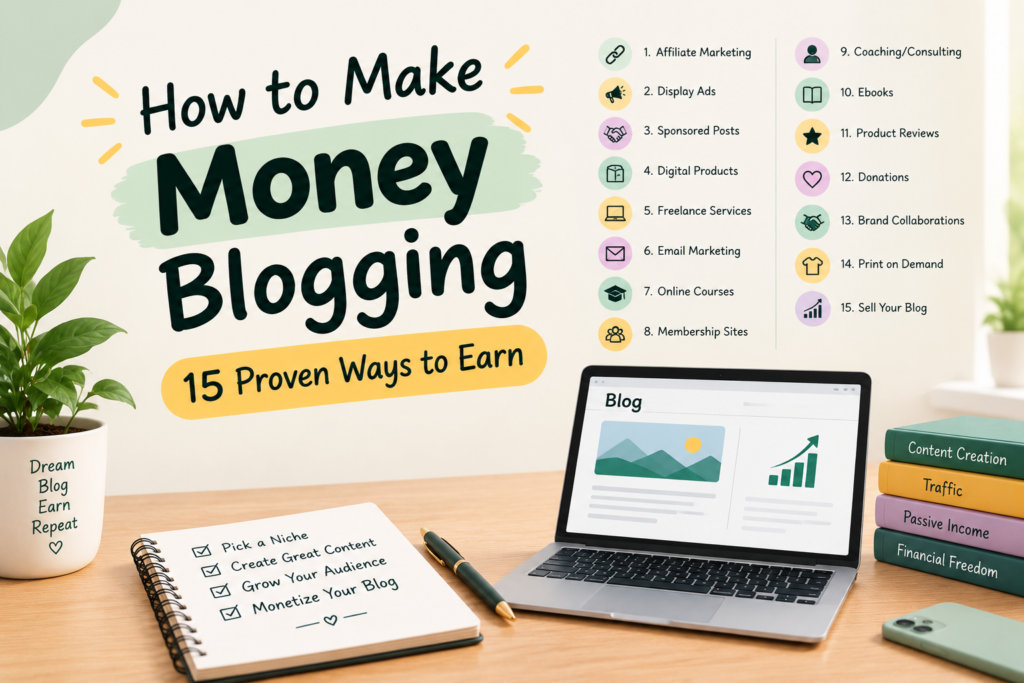
How to Make Money Blogging: 15 Proven Ways to Earn Online
Introduction
How to make money blogging is a common question for people who want to earn money online and build a flexible source of income. Blogging allows you to share your knowledge, help readers solve problems, and earn money through different online business methods. You do not need a physical office or a large investment to get started. With a computer, an internet connection, and useful content, you can begin building your own blog.
However, blogging is not a get-rich-quick method. It takes time to create quality articles, attract visitors, build trust, and develop reliable income sources. Some bloggers start earning within a few months, while others need a year or longer to see meaningful results. Your progress depends on your niche, content quality, marketing strategy, competition, and consistency.
The good news is that there are several ways to monetize a blog. You can display advertisements, promote affiliate products, sell digital products, offer services, or work with brands. You can also combine multiple methods to increase your earning potential.
In this guide, you will learn 15 practical ways to make money blogging, choose a profitable niche, attract organic traffic, and turn your blog into a long-term online business.
What Is Blogging and How Does It Work?
Blogging means publishing articles on a website about a specific subject or group of related topics. A blog can cover personal finance, technology, education, travel, lifestyle, online earning, health, or other areas of interest.
Bloggers create content that answers questions, explains problems, compares products, or teaches readers something useful. When people find these articles through search engines, social media, or other websites, the blog receives visitors.
Those visitors can eventually generate income.
For example, imagine you create a blog about online earning. You publish helpful articles about freelancing, remote jobs, blogging, and digital products. As your website attracts visitors, you can earn money by displaying advertisements, recommending useful tools, or selling your own guides.
The basic process looks like this:
- Choose a niche for your blog.
- Create a website and publish helpful articles.
- Optimize your content for search engines.
- Attract relevant visitors.
- Build trust with your audience.
- Monetize your traffic through suitable income sources.
The key is to focus on helping readers first. When your content provides real value, it becomes easier to build an audience and develop earning opportunities.
1. Choose a Profitable Blogging Niche
Choosing the right niche is one of the most important steps when learning how to make money blogging. Your niche determines the type of content you publish, the audience you attract, and the monetization methods available to you.
A profitable niche usually has an interested audience, enough topics to cover, and products or services that readers may want to purchase.
Here are some popular blogging niches:
- Personal finance: Saving money, budgeting, investing education, and financial planning.
- Online earning: Freelancing, remote jobs, side hustles, and digital businesses.
- Technology: Software reviews, tutorials, apps, and productivity tools.
- Education: Study guides, learning resources, and career advice.
- Lifestyle: Home organization, personal development, and everyday solutions.
- Travel: Destination guides, travel tips, and accommodation recommendations.
- Food: Recipes, meal planning, and cooking tutorials.
Do not choose a niche only because someone claims it generates high income. Consider your knowledge, interests, audience needs, and ability to produce useful content consistently.
For example, if you already enjoy writing about online earning, you could focus on freelancing opportunities, work-from-home jobs, blogging, and digital products. This approach helps you build topical relevance and create related articles for the same audience.
2. Start a Blog With a Reliable Website
After selecting your niche, the next step is to create your website. You can start with a free blogging platform, but a self-hosted WordPress website gives you more control over your design, content, plugins, and monetization options.
To start a WordPress blog, you generally need a domain name, web hosting, and a WordPress installation.
Your domain should be easy to remember, relevant to your topic, and simple to spell. Choose a reliable hosting provider that offers good performance, security features, and customer support.
Once WordPress is installed, select a clean, mobile-friendly theme. Avoid cluttering your website with unnecessary animations, pop-ups, or too many plugins.
Make sure your website includes essential pages such as:
- About Us
- Contact Us
- Privacy Policy
- Terms and Conditions, where appropriate
- Affiliate Disclosure, when using affiliate links
These pages help visitors understand your website and its policies. Some monetization programs may also require certain disclosures or other website information.
You do not need an expensive design to begin. A fast, readable, well-organized website is more useful than a complicated design that distracts readers.
3. Publish Helpful and Original Blog Posts
Content is the foundation of a successful blog. If your articles answer real questions and provide useful information, readers have a reason to visit your website.
Before writing an article, identify what your audience wants to know. Research the topic, organize the information, and explain it in clear language.
For example, a blog about online earning could publish articles such as:
- How to Make Money Blogging
- Best Side Hustles for Beginners
- How to Sell Digital Products Online
- Work From Home Jobs for Beginners
- How to Start Freelancing With No Experience
Each article should have a clear purpose and offer information that readers can use.
Use descriptive headings, short paragraphs, relevant examples, and practical steps. Include original insights whenever possible instead of repeating the same generic information available on many other websites.
Avoid publishing large numbers of low-quality articles simply to increase your post count. A smaller collection of genuinely useful articles can be more valuable than hundreds of repetitive posts.
You can use AI tools to brainstorm ideas, outline articles, or improve readability, but review every draft carefully. Check factual accuracy, add your own expertise, and make sure the final article provides genuine value.
4. Make Money Blogging With Display Advertising
Display advertising is one of the most familiar ways to monetize a blog. An advertising network places ads on your website and may pay you based on impressions, clicks, or other agreed metrics.
For example, Google AdSense allows eligible publishers to display ads on their websites. Other advertising networks may have different eligibility requirements, traffic expectations, and payment conditions.
The amount you earn depends on several factors, including visitor location, topic, advertiser demand, page views, and ad placement.
A website with visitors from countries where advertisers spend more may earn more per thousand page views than a similar website with visitors from lower-advertising-spend markets. However, results vary widely and are never guaranteed.
To improve your advertising potential:
- Publish original and useful articles.
- Follow the advertising network’s policies.
- Improve website speed and mobile usability.
- Attract relevant organic traffic.
- Use reasonable ad placements that do not harm readability.
Do not click your own advertisements or encourage visitors to click them artificially. Invalid traffic can lead to withheld earnings or account restrictions.
Advertising can become a useful income source as your traffic grows, but it is usually better to focus on content and audience development before expecting significant revenue.
5. Earn Through Affiliate Marketing
Affiliate marketing allows bloggers to earn commissions by recommending products or services. You join an affiliate program, receive a special tracking link, and include it in relevant content.
If a reader follows your link and completes a qualifying purchase or action, you may receive a commission according to the program’s terms.
For example, a technology blogger might recommend website hosting, productivity software, or blogging tools. A personal finance blogger might review budgeting software or educational resources where promotion is permitted.
To succeed with affiliate marketing, recommend products that are relevant to your audience. Explain their features, benefits, limitations, and suitable use cases.
Useful affiliate content includes:
- Product comparisons
- Detailed reviews
- Beginner buying guides
- Tutorials explaining how a tool works
- Articles comparing free and paid alternatives
Always disclose affiliate relationships clearly. Readers should know when you may earn a commission from their purchases.
Do not recommend products simply because they offer high commissions. Honest recommendations help preserve reader trust and make your content more useful.
Affiliate marketing can work even before you have massive traffic, provided you attract readers with a genuine interest in the products you cover.
6. Sell Digital Products on Your Blog
Selling digital products is another effective way to monetize a blog. Digital products can be created once and sold repeatedly, although they still require maintenance, marketing, customer support, and occasional updates.
Popular digital products include:
- E-books
- Printable planners
- Budget spreadsheets
- Online guides
- Canva templates
- Checklists
- Website templates
- Educational workbooks
Suppose your blog teaches people how to earn money online. You could create a beginner’s guide to starting a freelance business or a spreadsheet for tracking side-hustle income.
Start by identifying a problem your audience frequently experiences. Then create a product that helps solve that problem in a practical way.
You can sell digital products through your own website or a suitable digital marketplace. Before choosing a platform, review its fees, payment options, country availability, and rules.
Make your product description clear and explain exactly what buyers will receive. Offer sample pages or previews when possible.
Digital products can provide higher revenue per sale than some advertising methods, but success depends on product quality, audience demand, pricing, and promotion.
7. Offer Freelance Services Through Your Blog
Your blog can act as a portfolio that demonstrates your skills and attracts potential clients.
If you write helpful articles about a subject, visitors may recognize your knowledge and contact you for professional assistance.
Depending on your abilities, you could offer:
- Blog writing
- Copywriting
- SEO content writing
- Website design
- WordPress setup
- Social media management
- Graphic design
- Virtual assistance
- Content editing
For example, a blogger who publishes detailed SEO tutorials can create a service page offering keyword research or on-page optimization.
Include examples of your work, a description of your services, and a simple way for clients to contact you. If you have genuine testimonials or case studies, display them with permission.
You can also publish articles that answer questions your ideal clients search for. This can attract people who already need the services you offer.
Freelancing is especially useful for beginners because you do not necessarily need thousands of monthly visitors to find your first client. A small audience with the right needs may be more valuable than a large but unrelated audience.
8. Write Sponsored Blog Posts
Companies sometimes pay bloggers to publish sponsored content that introduces their products, services, or expertise to a relevant audience.
For example, a company selling website tools may collaborate with a blogging website that attracts entrepreneurs and content creators.
Sponsored posts may include product explanations, tutorials, interviews, or campaign-specific articles. The exact arrangement depends on the agreement between the blogger and the company.
To attract sponsorship opportunities, build a professional website and publish content related to a clear audience. You can create a media kit containing your niche, audience information, traffic statistics, engagement data, and collaboration options.
Contact relevant brands with a concise proposal explaining how your website could help them reach potential customers.
Always label sponsored content clearly and follow applicable advertising disclosure rules. Do not publish misleading claims or accept promotions that could damage your credibility.
You should also consider whether a sponsored article genuinely benefits your readers. A short-term payment is rarely worth losing the trust of your audience.
9. Create an Email Newsletter
An email newsletter helps you maintain a direct relationship with readers. Search engine rankings and social media reach can change, but an email list gives you a way to communicate with subscribers who have chosen to hear from you.
Offer a useful reason for people to subscribe. This could be a free checklist, a short guide, a collection of resources, or regular tips related to your niche.
For example, a blog about online earning could offer a free checklist for starting a side hustle. Readers who find the checklist useful may subscribe to receive additional advice.
Once you have subscribers, send helpful emails consistently without overwhelming them. Share new articles, practical recommendations, product updates, or relevant resources.
You may eventually monetize your newsletter through affiliate recommendations, your own products, sponsorships, or paid subscriptions.
Obtain permission before sending marketing emails and provide a clear unsubscribe option. Respect subscriber privacy and follow the rules that apply to your audience.
An email newsletter is not usually an instant source of income, but it can strengthen several other monetization methods.
10. Offer Online Courses and Workshops
If you have substantial knowledge of a subject, you may be able to turn it into an online course or workshop.
Courses work best when they teach a specific skill or help learners achieve a clear goal. Examples include beginner SEO, WordPress website setup, content writing, graphic design, or basic spreadsheet skills.
Start by identifying a topic your readers repeatedly ask about. Create a structured curriculum with lessons, demonstrations, exercises, and practical examples.
You do not need to create a huge course immediately. A focused workshop that solves one important problem may be a better starting point.
You can host your course on an appropriate learning platform or sell access through your own website. Check platform fees, payment support, and technical requirements before making a decision.
Explain what students will learn and who the course is designed for. Avoid promising guaranteed income, employment, or other outcomes that you cannot control.
A course requires planning and ongoing support, but it can turn your knowledge into a valuable product while helping readers develop useful skills.
11. Offer Paid Memberships or Premium Content
A membership website provides subscribers with access to exclusive content or community features in exchange for recurring payments.
Depending on your niche, you might offer detailed tutorials, downloadable resources, expert discussions, private workshops, or a members-only newsletter.
For example, a blogging education website could provide premium SEO checklists, content planning templates, and monthly training sessions.
Before introducing a paid membership, build a foundation of free content and understand what your audience wants. Ask readers about the problems they would pay to solve.
Clearly explain the membership benefits, price, billing frequency, cancellation process, and any limitations.
Recurring revenue can make your income more predictable, but it is not guaranteed. You must continue delivering value so members have a reason to remain subscribed.
Start with a simple membership offer and improve it based on actual feedback rather than building an elaborate system before confirming demand.
12. Use SEO to Attract Free Organic Traffic
Search engine optimization, commonly called SEO, helps search engines understand your content and helps readers discover your articles through relevant searches.
Organic search traffic can be valuable because visitors often arrive while looking for information about a specific problem.
Begin with keyword research. Identify the phrases your audience uses and examine the search intent behind them.
For example, someone searching for “how to make money blogging” probably wants a beginner-friendly explanation of blogging income methods. An article that answers this question directly is more relevant than an unrelated personal story.
Follow these SEO practices:
- Include your focus keyword naturally in the SEO title.
- Write a clear meta description.
- Use a short, descriptive URL slug.
- Mention the main keyword near the beginning of the article.
- Include relevant phrases in suitable H2 and H3 headings.
- Use descriptive image alt text.
- Link to related articles on your website.
- Cite trustworthy sources when appropriate.
- Make your website fast and mobile-friendly.
Avoid keyword stuffing. Repeating the same phrase excessively can make content difficult to read and does not guarantee better rankings.
SEO takes time, and no one can guarantee a first-page ranking. Focus on search intent, content usefulness, website quality, and continuous improvement.
13. Promote Your Blog on Social Media
Social media can help introduce your articles to readers who may not discover them through search engines.
Choose platforms that match your content and audience. Pinterest may be useful for visually oriented guides, while LinkedIn can help professional and business-focused blogs. Facebook groups and other communities may also provide relevant opportunities when promotion is permitted.
Do not simply post the same link repeatedly. Turn your article into smaller pieces of useful content.
For example, an article about blogging income could become a short checklist, a series of tips, an infographic, or a short educational video.
Share practical information that encourages people to visit your website when they want more detail.
Participate in relevant discussions and follow each platform’s rules. Avoid spam, fake engagement, and misleading headlines.
Social media traffic can fluctuate, so use it alongside other channels rather than relying entirely on one platform.
14. Sell Physical Products or Merchandise
Although many bloggers focus on digital products, physical products can also be a source of income.
A food blogger might sell a cookbook, while a fitness education blog might offer branded merchandise or suitable training accessories. A craft blogger could sell handmade items or tools relevant to the audience.
You can use your blog to explain the product, demonstrate its usefulness, and answer common customer questions.
Before launching, calculate production costs, packaging, delivery, platform fees, returns, and customer service expenses. The amount left after these costs determines whether the business is financially worthwhile.
You should also confirm that your chosen payment processor and selling platform support your country and preferred delivery arrangements.
Avoid buying large amounts of inventory before validating demand. Small product launches or made-to-order arrangements may reduce the risk of unsold stock.
Physical products require more logistics than digital downloads, but they can fit naturally into certain blogging niches.
15. Build a Long-Term Blogging Business
The strongest blogging businesses often combine several complementary income sources.
For example, a website might earn from advertisements, affiliate marketing, freelance services, and digital products. Each method serves a different purpose and may appeal to different readers.
However, trying every monetization method at once can waste time. Begin with one or two approaches that match your current traffic, skills, and audience.
Track useful measurements such as:
- Monthly website visitors
- Search impressions and clicks
- Email subscribers
- Affiliate link clicks and conversions
- Product sales
- Advertising revenue
- Business expenses
Use these measurements to identify what is working. If an article receives search traffic but generates few affiliate clicks, you might need to improve the product’s relevance or make your recommendations clearer.
If a page attracts impressions but few clicks, review its title and meta description. If readers leave quickly, check whether the article answers their question effectively.
Review your results regularly and make changes based on evidence rather than guessing.
How Much Money Can You Make From Blogging?
Blogging income varies widely. Some blogs earn nothing for a long time, some generate occasional small payments, and others develop into profitable businesses.
Your income may depend on traffic volume, audience location, niche, monetization strategy, conversion rates, advertiser demand, and the quality of your offers.
Consider this simplified example of a hypothetical month:
| Income source | Example monthly revenue |
|---|---|
| Display advertising | $100 |
| Affiliate commissions | $150 |
| Digital product sales | $200 |
| Freelance services | $250 |
| Total revenue | $700 |
These numbers are illustrative only, not a typical result or an earnings guarantee. Your actual income could be much lower or higher. Revenue is also different from profit because hosting, software, payment processing, taxes, and other business costs must be considered.
A beginner should focus first on publishing helpful content and understanding audience needs rather than expecting to earn a specific amount by a certain date.
Common Blogging Mistakes to Avoid
Many beginners struggle because they focus on quick results instead of building a useful website.
Here are common mistakes to avoid.
1. Choosing a niche without research
A topic should have an identifiable audience and enough useful content opportunities. Research before committing to it.
2. Publishing low-quality content
Articles that repeat existing information without adding value may struggle to attract loyal readers. Provide accurate explanations, examples, and original insights.
3. Ignoring SEO
Useful content still needs clear organization and discoverability. Learn basic keyword research, internal linking, and technical website maintenance.
4. Expecting instant income
Blogging requires patience. Build your audience and test monetization methods before depending on the website for regular income.
5. Using too many advertisements
Excessive ads can make reading difficult and frustrate visitors. Prioritize usability and follow advertising policies.
6. Promoting unsuitable products
Unrelated or unreliable recommendations can damage reader trust. Choose products carefully and disclose commercial relationships.
7. Ignoring website performance
Slow pages, broken links, and poor mobile layouts can negatively affect the visitor experience. Test your website regularly.
Learning from these mistakes can help you build a more sustainable blogging strategy.
A Simple 90-Day Blogging Plan for Beginners
If you want to know how to make money blogging, a practical plan can help you move from an idea to a working website.
Days 1–30: Build Your Foundation
Choose a niche, set up your website, create essential pages, and research your audience. Publish your first useful articles and organize them into relevant categories.
Focus on quality rather than publishing as many posts as possible.
Days 31–60: Improve Your Content
Publish additional articles targeting related search queries. Add internal links between relevant posts, improve older content, and set up suitable website analytics and search performance tools.
Start sharing your articles through relevant channels and consider creating a simple email signup offer.
Days 61–90: Test Monetization
Review which articles attract visitors and what readers seem interested in. Depending on your website’s eligibility, you could apply to an advertising network, join relevant affiliate programs, or offer a small digital product or service.
Check the terms and eligibility rules of each program before applying.
At the end of 90 days, evaluate your progress. You may not have significant income yet, but you should have a clearer understanding of your audience, content performance, and next steps.
This timeline is a starting framework, not a promise that you will achieve specific traffic or revenue results within three months.
Conclusion
Learning how to make money blogging involves more than publishing articles and waiting for visitors. You need to choose a suitable niche, create helpful content, attract the right audience, and develop monetization methods that match your readers’ needs.
Display advertising, affiliate marketing, digital products, freelance services, sponsored posts, newsletters, courses, and memberships can all provide earning opportunities when used appropriately.
Start with a clear plan, publish original and useful articles, and improve your website based on real performance data. Avoid shortcuts that compromise content quality or reader trust.
Most importantly, remember that blogging is a long-term project. Consistent effort, realistic expectations, and a willingness to learn can help you build a website that grows into a valuable online business over time.
Read Next
Pingback: Affiliate Marketing for Beginners: 15 Easy Ways to Earn Online